California Safe Driver presents
For Juveniles · 2.5-hr live, instructor-led online class · Court and Agency Referrals
An E-Bike Diversion Class for Juveniles
A live, instructor-led online class that changes how young riders make decisions. No cost to your agency and no case management: it’s student-funded and run by California Safe Driver, from referral to certificate. See how
The 80/20 Method80% decision-making and behavior. 20% rules.
Behavior Based ProgramCBT-informed instruction that changes how a rider decides.
Developed by a team of experienced law enforcement officers, educators and National Safety Council–trained defensive driving instructors. Presented by California Safe Driver, trusted by California courts and agencies since 2009. Live, instructor-led online classes run on an ongoing basis.
Youth e-bike injuries are up 300%.
Minors account for a growing share of crashes, and every citation still needs somewhere to go.
See the data For Law EnforcementA referral, not a court date.
Every classification, the law that actually applies, and a free briefing for your agency.
See the resource What We Offer80% behavior. 20% rules.
Knowing the rules does not change how a 13-year-old rides through an intersection. Practicing the decision does.
See the programEvidence-Informed · Behavior Based · Interactive
Safer riding starts with better decisions.
E-Bike Dynamics™ is a youth-centered, behavior based program that goes beyond traditional safety instruction, helping young riders examine real-world consequences and build the judgment to ride safer.
Why It Matters
What the data shows.
E-bikes put moped-level speed in the hands of riders who have never held a license. The injury data isn’t trending in the right direction, and minors are absorbing a disproportionate share of it.
Inexperience is one significant factor behind those collisions: riders who never learned the rules of the road, and who figured a crash like that couldn’t happen to them. In Marin County, data collected from October 2023 onward found riders ages 10 to 15 about five times more likely to require an EMS response than other age groups.7
These aren’t outliers. They’re the pattern this course is built to interrupt, and every close call that doesn’t end in a hospital visit still lands on an officer’s desk. Departments are already looking for a better answer than a fine: Santa Clara County’s Sheriff’s Office revived a juvenile traffic diversion program in 2026 because, in their words, “education, not fines, can help change behavior and prevent serious injuries.”5
For Law Enforcement
Classifications clarified. Diversion simplified.
What your agency gets
- Live, instructor-led online classes, offered on an ongoing basis
- A Certificate of Completion for every referred rider
- Proof of completion includes the student’s Certificate of Completion and the signed Child Parent Safe Rider Agreement.
- Referral letters with your agency’s logo and the enrollment link
- A free 20-minute LE briefing training and printable cheat sheet
- No cost to your agency and no case management
Know what you stopped. California treats e-bikes, motorized scooters and mopeds or electric motorcycles very differently, and getting the classification right determines whether a citation belongs in traffic court at all.
E-Bike Dynamics™ · California Safe Driver · [email protected]
California classifications at a glance. Verify current Vehicle Code language before citing.
| Device | Motor stops / limit | License | Plate | Min. age | Helmet |
|---|---|---|---|---|---|
| No license · No plate | |||||
| Class 1 e-bike, CVC §312.5(a) | 20 mph · pedal-assist only* | None | None | None | Under 18 |
| Class 2 e-bike | 20 mph · throttle, pedal-assist optional | None | None | None | Under 18 |
| Class 3 e-bike | 28 mph · pedal-assist only* · speedometer required | None | None | 16 | Everyone |
| License and/or plate required | |||||
| Motorized scooter, CVC §407.5(a) | 15 mph speed limit (§22411) | Driver’s license or permit | None | 15½ with permit · 16 with license | Under 18 |
| Moped / motorized bicycle, CVC §406(a) | 30 mph max · under 4 hp | M1 or M2 | Moped plate | 15½ with permit · 16 with license | Everyone |
| Electric motorcycle | Over 30 mph | M1 | Required | 15½ with permit · 16 with license | Everyone |
For e-bikes, the speed is where the motor must stop helping. Riders can still go faster by pedaling or downhill.
* Since Jan. 1, 2025 (SB 1271), Class 1 and Class 3 e-bikes can’t have a throttle, except a walk-assist up to 3.7 mph.
Off-highway electric motorcycles with only an OHV identification sticker are not street legal.
The classes depend on when the motor stops helping: 20 mph for Class 1 and Class 2, and 28 mph for Class 3. A Class 3 must also have a speedometer. If a bike’s motor is more than 750 watts, it keeps helping past its class limit (for example, after the speed limiter is removed), or its pedals have been removed, it no longer meets the e-bike definition in CVC §312.5(a). It may then be treated as a motorized bicycle, moped or motorcycle, with the licensing, registration and insurance rules that go with it. Motorized scooters are covered by separate laws: CVC §22411 (15 mph limit) and CVC §21235.
Note on Class 1 and Class 3 e-bikes: since January 1, 2025 (SB 1271), Class 1 and Class 3 e-bikes can no longer have a throttle that works above 3.7 mph (walk-assist). It’s not yet clear how bikes bought before 2025 should be handled, so follow your agency’s policy. We’ll update this as guidance becomes available.
The two consequences nobody else teaches
Every other conversation about e-bikes stops at the citation. This is the part of the course built specifically for the families who never see it coming, and the reason a diversion referral often lands better than a fine.
Consequence A · Parental liability
The fine isn’t just the rider’s
Under CVC §21212(e), a parent or legal guardian is jointly and severally liable with their minor for the fine on a helmet citation. Most parents who buy their child an e-bike have no idea they’ve taken on that liability until a citation arrives with their name on it too.
Consequence B · Reclassification
A modified bike isn’t a bike anymore
Two separate laws are at work. Under CVC §24016(d) an e-bike may not be tampered with or modified so as to change its speed capability unless it is relabeled and still meets a Class 1, 2 or 3 definition. That relabeling exception came in with AB 1096 in 2015. AB 1774, signed in 2024, narrowed it: a modification may not take the bike outside the e-bike definition at all, and it separately banned selling a product or device that modifies an e-bike’s speed capability so that it no longer meets the e-bike definition (§24016(e)). The reclassification itself comes from CVC §312.5(a): once a modified bike no longer meets the e-bike definition it is a motorized bicycle, moped or motorcycle, and the licensing, registration and insurance rules for that classification apply.
New for 2026
AB 545: selling speed-unlock apps and other speed-modification products is banned.AB 875: police can impound a vehicle with fewer than four wheels that isn’t a legal e-bike and can go over 20 mph on its motor alone when the rider has no license, and a Class 3 e-bike ridden by anyone under 16 (CVC §22651.08). Minimum hold: 48 hours.AB 965: Class 3 e-bikes can’t be sold to anyone under 16.SB 586: “off-highway electric motorcycles” (no pedals, straddle seat) are a separate category, not e-bikes.AB 544: e-bikes need a red rear light or reflector at all hours (CVC §21201(f)).- Helmet tickets for riders under 18: the fine can be waived if, within 120 days, the family shows proof of a helmet and a completed specialized e-bike safety course (
CVC §21212(f)). SB 1271: e-bikes and e-bike batteries sold in California must be lab-certified (since Jan. 1, 2026).
Coming Jan. 1, 2027
AB 2346: 10 mph max for bikes and e-bikes wherever sidewalk riding is allowed, unless the city posts a different limit. Cities still decide whether sidewalk riding is allowed (CVC §21206). Motorized scooters stay banned from sidewalks statewide (CVC §21235(g)).SB 1167: vehicles faster or more powerful than the three e-bike classes can’t be sold as e-bikes.
This area of law changes nearly every legislative session. Section numbers and statute language should be verified against current California Legislative Information before citing to a family or in a report.
Enforcement is escalating. Warnings have given way to citations and impounds, and a growing number of California agencies now put a drone over riders who run from a stop rather than a helicopter, because it is cheaper and safer than a pursuit.8 That is the direction this goes if nothing changes upstream, and it is a costly, adversarial way to reach a young rider. A diversion referral reaches the same rider earlier, at a fraction of the cost, with a better chance of changing what they do next time.
Designed for juvenile diversion
E-Bike Dynamics™ provides agencies and communities with an educational alternative to a citation in appropriate cases of juvenile e-bike violations and unsafe riding behavior. The program provides an opportunity to promote education, accountability and positive behavior change.
The program may be appropriate for referrals from
- Police Departments
- School Resource Officers
- Traffic Units
- Juvenile Courts
- Probation Departments
- Diversion Programs
- Schools
How a referral works
- Citation issued
- Referred to Diversion
- Family enrolls
- Course completed
- Certificate issued
- Case closed
Your agency issues or receives the citation and refers the rider to E-Bike Dynamics in lieu of a court date, probation hearing or fine. The juvenile enrolls at the family’s expense, completes the live course, and returns their Certificate of Completion to your agency, closing the case without a court filing. We simplify and automate the compliance process so families can send both the Certificate of Completion and the signed Safe Rider Agreement to the referring agency in one email.
We make the process simple, with no cost to your agency. We supply the referral letter, with your agency’s logo and the enrollment link on it. An optional staff portal lets your staff check a juvenile’s progress, but no case management is required on your side. The program is student-funded, and the only thing that comes back to you is the certificate.
A young rider pops a wheelie through a crosswalk as a car closes in: the split-second decision this program is built to change.
Every ride is a decision
One wheelie. One bad choice. An E.R. visit, not just a citation.
Riders know the rule; nobody has made them rehearse the decision. This program does, and gives your agency somewhere to send them besides a courtroom.
Sources
- San Diego pediatric e-bike accidents, +300% (2019–2023). Presented at the 2026 American Academy of Orthopaedic Surgeons (AAOS) annual meeting. ↩︎
- Flyer, Z.E., et al. (2025). Pediatric e-bike injury study: 71% of ~15,000 injuries studied were ages 13–18. Injury, December 2025 issue. ↩︎
- American College of Surgeons (ACS) Bulletin coverage, cross-referenced with California pediatric trauma center data: minors under 18 account for roughly 35% of the e-bike-related traumatic injuries reviewed. The Bulletin discusses worldwide injury experience; this is not a U.S. national estimate. ↩︎
- Synthesis of NEISS injury-surveillance data with the Flyer et al. (2025) study and ACS/AAOS injury-trend commentary, linking rising injury rates to modifications, excessive speed and low helmet use. ↩︎
- Santa Clara County Sheriff’s Office, Juvenile Traffic Diversion Program, 2026. ↩︎
- National Electronic Injury Surveillance System (NEISS) estimates for 2024 and 2025: roughly 41% of e-bike emergency-department visits were patients ages 10 to 19; reported by Axios, July 2026. ↩︎
- Marin County data collection beginning October 2023: youth ages 10 to 15 were about five times more likely to require an EMS response than other age groups. This is an emergency medical services response rate, not an emergency-room visit rate. ↩︎
- Some California agencies, including Palm Springs and Irvine, now use drones. ↩︎
Figures above are drawn from the program’s facilitator guide and the peer-reviewed and conference sources it cites; injury data updates yearly, so verify current figures before citing in an official report.
What We Offer
E-bike safety requires more than knowing the rules.
E-Bike Dynamics™ is a structured, instructor-led e-bike safety and diversion program for juveniles. Presented by California Safe Driver, the program goes beyond instruction on e-bike laws.
At a glance: 2.5 hours · Live, instructor-led online class · For juveniles
E-bikes provide freedom and independence, but their speed and capabilities can place inexperienced riders in situations they may not be prepared to manage safely. All instructors have law-enforcement experience and are committed to traffic safety education, bringing practical knowledge of crashes, violations, accountability and the consequences of unsafe decisions into an engaging and supportive learning environment, and are certified by the National Safety Council to teach nationally recognized driver-safety programs, including Alive at 25® and Attitudinal Dynamics of Driving®. The goal is simple: help young riders make safer, more responsible choices before those choices result in injury, a citation, or tragedy.
Rather than reciting rules, the course uses CBT-informed strategies. An automatic thought shows up and shapes the choice a rider makes; the choice becomes a behavior, and the behavior produces an outcome that feeds the next automatic thought. In class, riders learn it as Catch it · Check it · Change it: catch the thought, check whether it’s true, and change it before they choose. That is what makes Think • Choose • Ride™ a behavior based method, not four related topics.
Information alone does not always change behavior. Through interactive scenarios, case studies, discussion, quizzes, role-play and activity-based exercises, students learn how their decisions influence outcomes.
The program runs across four connected sessions (Think, Choose, Ride and Outcome), separated by short breaks, a structure based on research on attention span rather than a scheduling convenience. Riders compete on a running team scoreboard through fast, hands-on activities; the Outcome session ends with each rider’s personal plan for the next ride. After class, the rider and a parent or guardian sign Our Riding Agreement together at home. Zoom can translate the class’s live captions into more than 35 languages.
Be aware
Think
Notice the thoughts and feelings that push you toward risk. Covers real e-bike speeds and stopping distances, the three e-bike classes, what makes a bike illegal, helmets, blind spots, and the thinking traps that lead to risky riding.
Make the right decision
Choose
Catch it. Check it. Change it. Pick the safer move. Covers handling peer pressure out loud, and riding responsibly and respectfully.
Ride responsibly
Ride
Put your choice into action, and know the rules. Covers spotting hazards on a real ride, California e-bike law, parental liability, modified bikes, sidewalk rules and the 60-second pre-ride check.
Your choice matters
Outcome
See where choices lead, for you and others, and plan your next ride. Covers real California cases, the full cost of one risky ride, a personal plan for the next ride, and a preview of Our Riding Agreement, which the rider signs with a parent after class.
For parents
Parents are part of the solution
Parents receive information about California e-bike laws, safety considerations and expectations for responsible riding.
The program covers
- E-bike safety and California law (can be adapted for any state on request)
- Decision-making and risk recognition
- Peer pressure and distraction
- Helmet, passenger, pedestrian and intersection safety
- Real-world scenarios and case studies
- Consequences and personal accountability
- Parent involvement
What riders receive
Student Playbook
Every rider keeps their Student Playbook, their own plan for the next ride, in their California Safe Driver account.
At-home reinforcement
Our Riding Agreement
After class, the parent gets an email link to Our Riding Agreement. Rider and parent review and sign it together at home, and the certificate of completion arrives as soon as both have signed. It covers keeping the bike legal, riding safely and weekly check-ins.
What riders receive
Certificate of completion
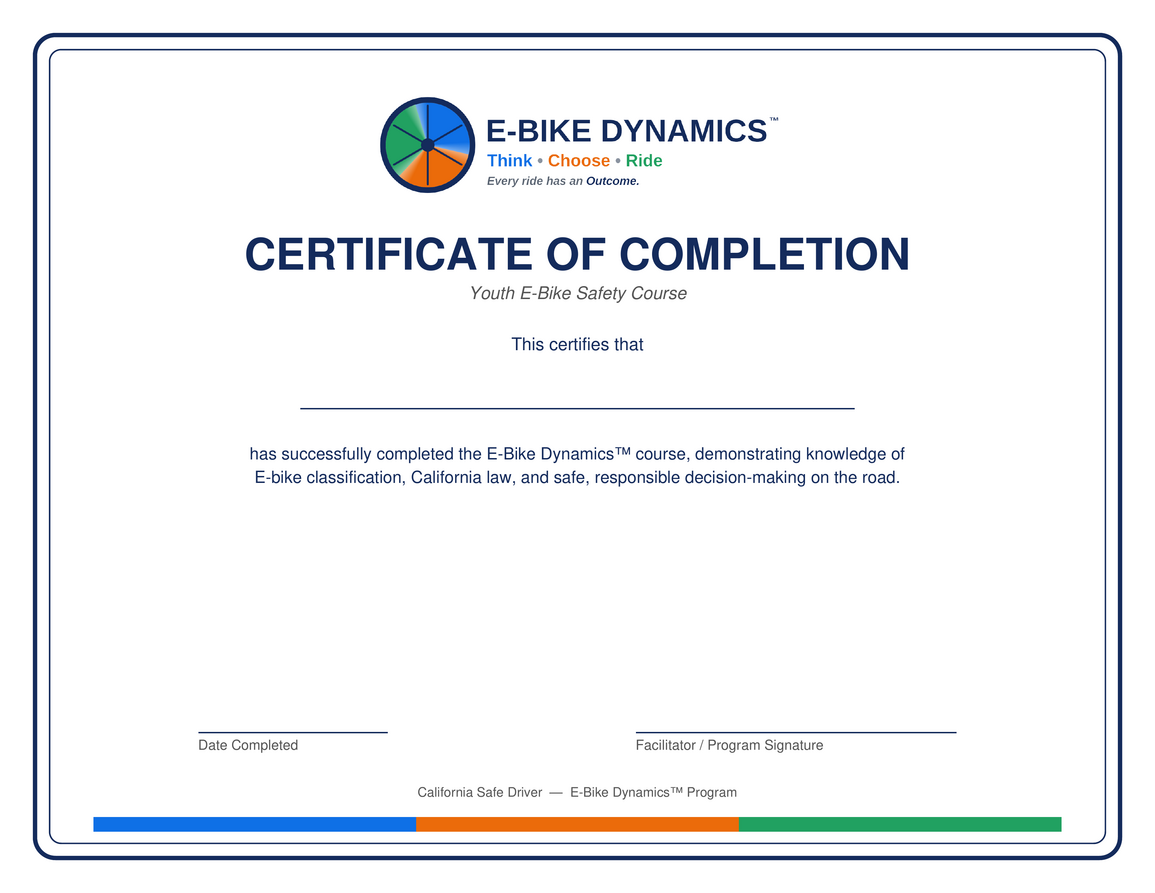
Emailed to students after class and maintained in their student account.
Referring agencies verify completion through the optional staff portal.
Every Ride Has an Outcome.
One decision can change everything.
The course rehearses the small decisions, one at a time, until the safer one comes first.
- A helmet.
- A passenger.
- A phone.
- An intersection.
- A few extra miles per hour.
Presented by California Safe Driver
E-Bike Dynamics™ is developed and presented by California Safe Driver, a provider of live, instructor-led traffic safety and behavioral education programs for courts, law-enforcement agencies, probation departments and communities throughout California. All instructors have law-enforcement experience and are committed to helping young riders develop safer decision-making habits through meaningful traffic safety education.
E-Bike Dynamics is built on an interactive, CBT-informed approach to learning, not a lecture. Every class is taught by instructors certified by the National Safety Council to teach Alive at 25® and Attitudinal Dynamics of Driving®. We use interactive learning tools to reinforce and assess understanding throughout the class, along with pre-class and post-class learning surveys. Anonymous student evaluations at the end of each class help us keep improving.
For additional information, email us at [email protected]